





Imagine this: Musterstadt municipal utility faces 500 concerned citizens in a packed council chamber. The question on everyone's mind: "What does the new Heat Planning Act mean for my heating?" After two hours of technical explanations, there's more confusion than clarity. This exact scene is currently playing out in municipalities across Germany – yet it could be solved much more efficiently.
The Heat Planning Act: New communication duties for towns and municipalities
Since January 2024, the Heat Planning Act (WPG) has obliged German municipalities to systematically plan their future heat supply. Large cities with over 100,000 inhabitants must submit a municipal heat plan by mid-2026; smaller municipalities have until mid-2028. But simply creating the plan is not enough – the Act explicitly demands comprehensive citizen participation and transparent communication.
The legal requirements are clear: municipalities must not only inform their citizens but actively involve them in the planning process. This means complex technical contexts, various energy source options, and individual impacts on homeowners must be communicated understandably. A mammoth task, considering topics like district heating expansion, hydrogen networks, and heat pump districts need to be prepared for laypersons. Many specifically ask: Is my gas heating still allowed long-term? Could a heating network be developed in my neighbourhood? Which government subsidies are available for a conversion? And which renovation costs and investment decisions depend on the municipal heat plan?
The communication challenge: Between technology and citizen proximity
Experience shows that traditional communication channels quickly reach their limits in heat planning. PowerPoint presentations full of technical diagrams overwhelm, multi-page PDF documents are rarely read, and citizen assemblies reach only a fraction of those affected. At the same time, the need for information is growing exponentially – after all, it concerns the long-term investment decisions of every property owner.
It becomes particularly challenging when different districts receive different solutions. While a district heating network might be developed in the old town, new development areas could rely on decentralised heat pumps. Communicating this complexity understandably while building acceptance requires innovative approaches to citizen communication.
Why explainer videos are the solution for municipal heat planning
This is where professional explainer videos come in – and for good reason. People demonstrably process visual information 60,000 times faster than plain text. With a topic as multifaceted as municipal heat planning, this makes the crucial difference between understanding and confusion.
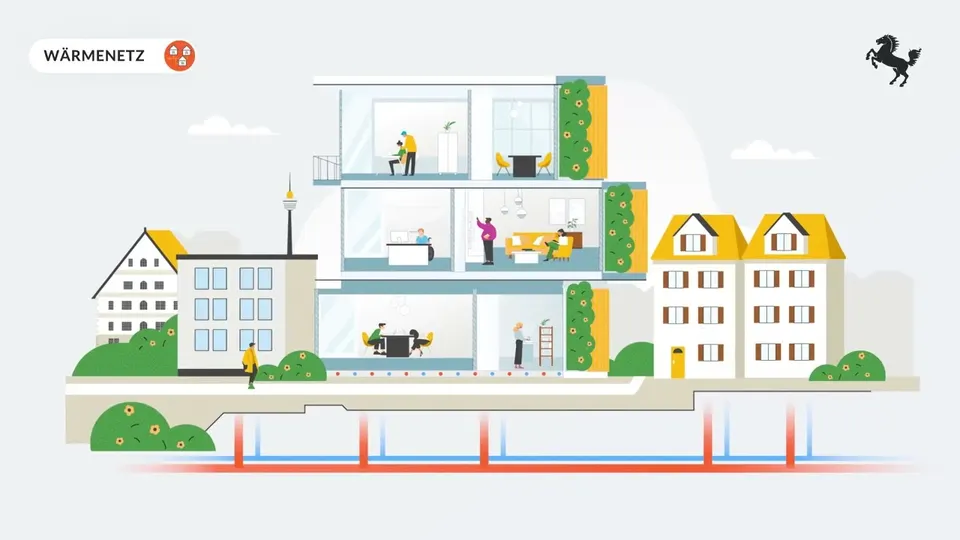
A well-designed explainer video on heat planning can convey in just two to three minutes what a presentation would take hours to do. Abstract concepts like heating networks become tangible through animations, different heating options can be visually compared, and the timeline of implementation becomes clear at a glance. Specifically, a good explainer video can convey the most important content of heat planning in 60–90 seconds, illustrate local specifics with maps and animations, and explain the connection between heat planning, the heating law, and subsidies understandably. The best part: a video produced once works around the clock – on the municipal website, on social media, or at citizen events.
The power of visual communication for complex energy topics
Experience shows that animated explanations work wonders, especially with technical topics. Instead of dry legal texts, citizens see how their city will develop. Instead of abstract CO2 saving targets, concrete benefits for the individual become visible. A professional explainer video manages to emotionally engage and professionally inform both the 25-year-old tenant and the 70-year-old homeowner.
This approach becomes particularly valuable when dealing with sensitive topics. Concerns about forced renovations or exploding heating costs can be much better dispelled through transparent, visual communication than through administrative jargon. An explainer video can alleviate fears by showing step-by-step what options are available to citizens and what subsidies are accessible.

Best Practices: How to succeed in heat planning communication via video
Successful explainer videos for municipal heat planning follow proven principles. They start with the citizens' current situation, not abstract climate goals. They visualise specific neighbourhoods and streets, instead of just showing theoretical concepts. And they offer clear recommendations for action, instead of leaving viewers with open questions.
The tone plays a decisive role. A good explainer video on heat planning conveys confidence and feasibility, without concealing the challenges. It uses clear, understandable language and avoids jargon – or explains it vividly. By using local references and realistic scenarios, identification is created instead of distance.
Integration into the municipal communication strategy
An explainer video on heat planning only unfolds its full effect in conjunction with other communication measures. It can serve as a central building block, integrated into the city's website, shown at citizen assemblies, and shared via social media. QR codes on information brochures lead directly to the video, email newsletters embed it, and local media are happy to pick up on the visual content.
The investment in a professional explainer video pays off multiple times. Municipal administration staff are relieved, as many basic questions are already answered in the video. The quality of citizen dialogues increases because all participants start from the same knowledge base. And last but not least, the municipality demonstrates modernity and citizen proximity – important factors for the acceptance of the heat transition.
Conclusion: Heat planning needs modern communication
The Heat Planning Act presents municipalities with unprecedented communication challenges. The good news: with professional explainer videos , a powerful tool is available that makes complex content understandable, citizen participation efficient, and the acceptance of the heat transition more likely.
Municipalities that invest in visual communication now not only create clarity for their citizens – they position themselves as modern, citizen-oriented administrations that actively shape change. Because one thing is certain: the heat transition will only succeed if all stakeholders understand what it is about and what role they play.